The House Call Flips: From All-Republican to 15-of-20 Democratic in a Month | MissedTakes Election Brief
A month ago, the handful of pundits willing to call House control outright were unanimous: three callers, three Republican picks. Today that field is twenty pundits deep, and fifteen of them say Democratic. The room didn't drift — it grew sevenfold and flipped wholesale. The Senate has moved less dramatically but in the same direction of growth: four callers a month ago, all Republican, are now twenty, with Republicans still ahead but by a much smaller margin (13 to 7) than the shutout it looked like in September.
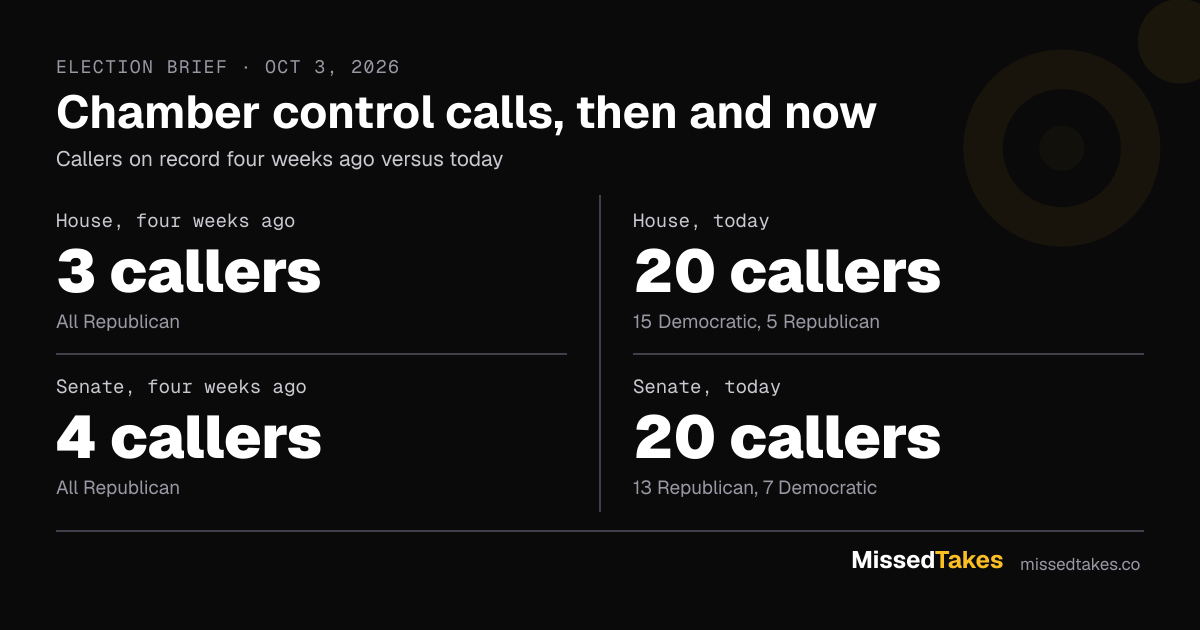
Inside that House number, forecasters and talkers aren't reading the race the same way. Four of the five forecasters in the field — modelers and ratings outfits — call it Democratic, versus one Republican holdout. Talkers lean the same way but less lopsidedly, 11-4. On the Senate side, the forecasters are split dead even, two and two, while the talkers favor Republicans 11-5 — the widest gap between what the modelers say and what the talking heads say anywhere on the board this week.
Kyle Kondik, a forecaster with no settled record to measure him against yet, illustrates how fast that House number can move for one person. On September 15 he wrote: "Add it all up and you get the following: R+2-6 from redistricting, with the range being determined by the 4 Toss-ups that Democrats are defending." One day later, on September 16, his seat count read: "HOUSE: 210 at least Leans D, 203 at least Leans R, 22 Toss-ups" — a reversal from a Republican-leaning House to a Democratic-leaning one in 24 hours.
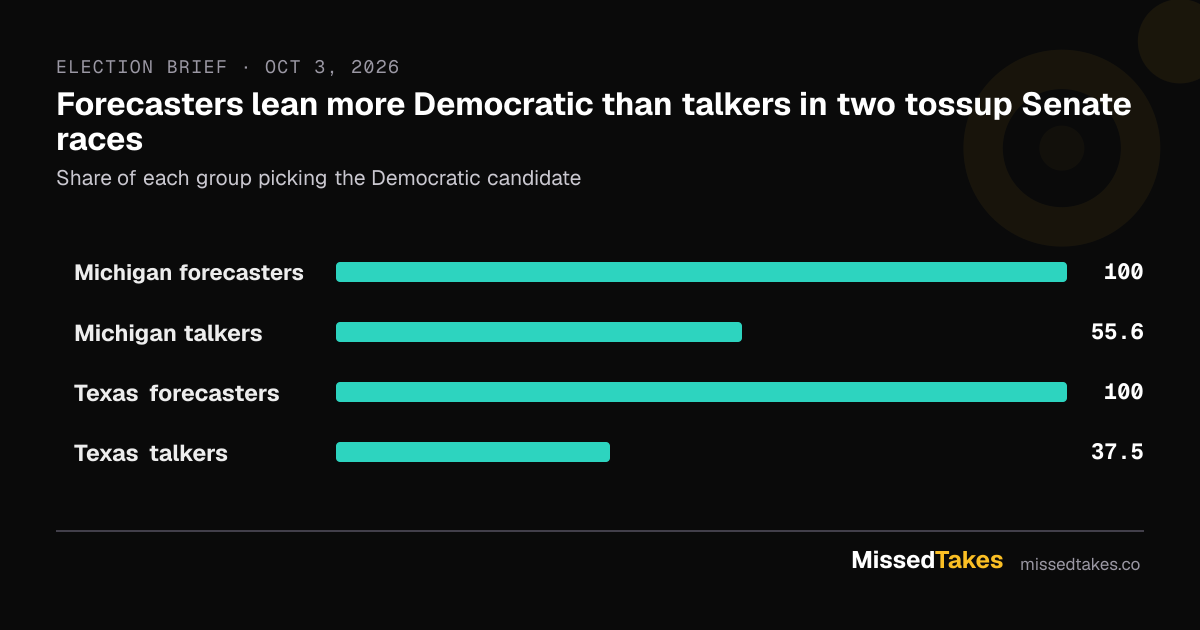
Forecasters vs. talkers in the two biggest Senate tossups
Michigan and Texas are the most-called non-incumbent Senate races on the board, and in both, forecasters are more bullish on Democrats than the talkers calling the same race. In Michigan, both forecasters in the field pick Abdul El-Sayed against Mike Rogers (Polymarket has El-Sayed at 73 cents, VoteHub's polling average has him up 3.2 points); talkers split closer to even, five to four. In Texas, both forecasters back James Talarico over Ken Paxton (Polymarket: 67 cents; VoteHub: Talarico by 2), while talkers actually lean the other way, five picks for Paxton against three for Talarico.
One pundit, two directions in Alaska
Ryan Girdusky, who carries a thin but perfect record so far (1 graded call, 100% accuracy, a MissedTakes Score of 102 — treat that as a lean, not a track record), changed his mind on Alaska's Senate race inside 48 hours. On September 28 he wrote: "I think Mary Patola is still going to lose in Alaska. I don't care what the polls say," picking the Republican. By September 30 he'd shifted to the specific candidate but kept the thought going: "And Mary Patola, for all Democrats' hopes, wishes, and dreams, She's been burning money pretty quickly... But I wouldn't be surprised if he pulls it out" — landing on Dan S. Sullivan. That puts him alone against three other callers in the race — James Brooks, Lakshya Jain and Carl Cannon — who all have Mary Peltola winning. Polymarket has Peltola at 72 cents with no listed price for Sullivan; VoteHub's average has her at 46.6%.
Two other pundits are standing alone this week. Buck Sexton is the only caller on New Hampshire's Senate race still picking John E. Sununu over Chris Pappas, against three others — worth noting given Sexton's record so far is a perfect 100% across 12 graded calls (MissedTakes Score 84.1). Mike Murphy is alone on Kansas for Adam Hamilton against three picking Roger Marshall, a lonelier bet given his record on the other end of the scale: 0% accuracy across four graded calls so far.
On the record
The 2026 cycle now holds 232 calls from 50 pundits, 125 of them filed in the last week alone. Ten of those pundits carry a graded record so far. Browse the full field on the election leaderboard or start from the US Elections hub.