Week 40: Senate Control Loosens Its Republican Grip, the House Doesn't Budge | MissedTakes Election Week
Twenty-nine days out, the loudest number in the room isn't a new consensus — it's an old one coming apart. Four weeks ago, 71.4% of the callers on Control of the Senate had it Republican. This week that share is down to 63.6%, even as the field calling it nearly doubled. Control of the House, by contrast, hasn't moved an inch: it was unanimous for Democrats a month ago and it's unanimous now, just with more people saying so.
The week in numbers
128 calls landed in the week ending October 5, pushing the cycle total to 250 calls from 48 pundits, nine of them tagged as forecasters rather than talkers. Race-winner picks still dominate the traffic — 169 calls on record, 84 of them this week — followed by chamber-control calls (43 total, 24 this week) and seat-count numbers (32 total, 16 this week). The national House popular vote and specific race margins remain rare: four and two calls respectively, with two of each arriving this week.
The field
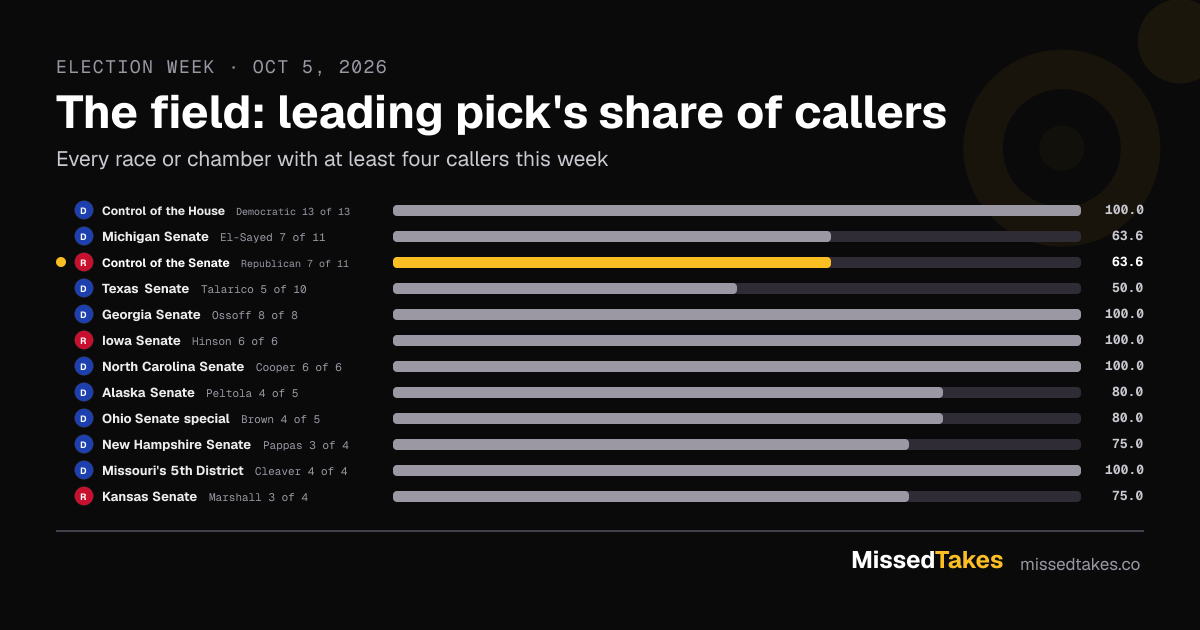
Three races are worth lingering on. Michigan's Senate race is the tightest the room has, and tighter than it looks: the field now runs 7-4 for Abdul El-Sayed over Mike Rogers (63.6%), barely moved from 4-2 a month back. But Polymarket prices El-Sayed at 73 cents and VoteHub's eight-poll average has him up only 3.2 points (48.0 to 44.8) — the room is less confident than the market, and the market is more confident than the polls.
Texas is a dead split: five callers for James Talarico, five for Ken Paxton, unchanged in share from a month ago even as the field doubled from six to ten. Chuck Todd called it for Talarico three separate times across the week (Sept. 28, Sept. 30, Oct. 5); Buck Sexton and Erick-Woods Erickson are both on Paxton.
Alaska moved the other way: Mary Peltola's share of the field rose from 66.7% to 80% over the month, even as Ryan Girdusky spent part of the week on the other side of it (more below).
Georgia, Iowa and North Carolina are the room's three settled races — unanimous for Jon Ossoff, Ashley Hinson and Roy Cooper respectively, each simply picking up more callers (Georgia's field doubled from four to eight, North Carolina's from three to six) without a single dissent. The Ohio special election cleared the four-caller bar for the first time this week, 4-1 for Sherrod Brown.
Forecasters against talkers
The forecasters are, if anything, ahead of the room's own consensus. G. Elliott Morris put the House at "a 99% chance that the Democrats will win 218 seats or more" and the Senate "up into the seventies," while David Nir put the national House popular vote at D+13 — well past Morris's own D+9. Kyle Kondik has had Michigan "Leans Democratic" since September 22 and hasn't moved off it.
Where the two groups genuinely split is Senate control: the nine talkers in the field run 6 Republican to 3 Democratic, but the two forecasters are tied 1-1 — the quant side of the room is already where the talkers are only starting to drift. Texas shows the same pattern in miniature: both forecasters call it for Talarico, but the eight talkers split 5-3 for Paxton. Georgia and Ohio's special election are the exception — forecasters and talkers agree there, unanimously for Ossoff and 3-for-3 for Brown among forecasters.
The room against the market and the polls
| Race | Room | Polymarket | VoteHub average |
|---|---|---|---|
| Michigan Senate | El-Sayed, 63.6% (7 of 11) | El-Sayed 73¢ | El-Sayed +3.2 (Sept. 30, 8 polls) |
| Texas Senate | Talarico, 50% (5 of 10) | Talarico 64¢ | Talarico +2.0 (Sept. 28, 4 polls) |
| Iowa Senate | Hinson, 100% (6 of 6) | Hinson 57¢ | Turek +2.0 (Sept. 28, 3 polls) |
| Kansas Senate | Marshall, 75% (3 of 4) | Marshall 68¢ | Hamilton +2.0 (Sept. 24, 2 polls) |
| Georgia Senate | Ossoff, 100% (8 of 8) | Ossoff 97¢ | Ossoff +9.6 (Oct. 3, 3 polls) |
| North Carolina Senate | Cooper, 100% (6 of 6) | Cooper 97¢ | Cooper +10.2 (Sept. 29, 4 polls) |
Iowa and Kansas are the two cases where the room and the betting market agree with each other and disagree with the live polling average. Every caller on Iowa has it for Hinson, and Polymarket has her at 57 cents — but VoteHub's three-poll average through September 28 actually shows Josh Turek ahead by two. Kansas runs the same way: a unanimous-minus-one room and a 68-cent market for Roger Marshall against a two-point Adam Hamilton lead in VoteHub's average.
Changed minds of the week
Chuck Todd moved on the Texas governor's race. On September 30 he was still calling it for Greg Abbott, hedging that "he's still the favorite to win, but he might lose... My guess is they come up a little short with Abbott." By October 5 he'd gone further: "It's unbelievable what they've done. And I do think Abbott loses... It's schools is why he loses." Hinojosa is his pick.
Girdusky moved twice inside Alaska in three days. On September 28: "I think [Peltola] is still going to lose in Alaska. I don't care what the polls say," naming the Republican side generically. By September 30 he'd gotten specific: "Mary Patola, for all Democrats' hopes, wishes, and dreams, she's been burning money pretty quickly... But I wouldn't be surprised if he pulls it out."
Standing alone
Four pundits are the lone holdout on their race this week. Girdusky's Sullivan pick in Alaska stands against four callers for Peltola. Jessica Anderson is alone on Jon Husted in Ohio's special election, against four for Brown. Buck Sexton is the one New Hampshire caller on John E. Sununu, against three for Chris Pappas — a race where Sexton carries a 100% accuracy mark on 12 graded calls last cycle. And Mike Murphy stands alone on Adam Hamilton in Kansas against three for Marshall, carrying a 0% accuracy mark on four graded calls last cycle — the kind of record that's worth knowing about before weighing his lone dissent too heavily.
On the record
Nothing here has a result yet — that's 29 days away. What's on the record is who said what, and when. For the full rundown of calls by race, see every race pundits called; for how pundits have fared once results do land, the election leaderboard and the US Elections hub are the place to look.