Michigan Pulls Away While Maine Splits From the Markets | MissedTakes Election Week
The week in numbers
Between October 5 and October 12, pundits and forecasters added 163 calls to the 2026 cycle, 170 since our last brief. The total now sitting on the board is 417 calls from 71 pundits, 11 of them forecasters in the formal sense (model-builders and ratings desks) and the rest talkers working the cable and podcast circuit.
Most of the week's volume was the simple stuff: 120 of the 163 new calls were race-winner picks, 25 were chamber-control calls, 13 put a seat total on the House or Senate, and 5 named a margin in a specific race. Nobody added a new national House popular-vote margin this week. None of this cycle's calls have been settled yet, with 22 days left before Election Day, so every number below describes where the field stands, not who is right.
The field
Twelve subjects drew four or more callers this week, from Control of the House (25 callers) down to the New Hampshire Senate race (7). In nine of the twelve, the leading pick holds at least three in four callers. The exception is Control of the Senate, where Republican still leads but at its thinnest margin of the group.
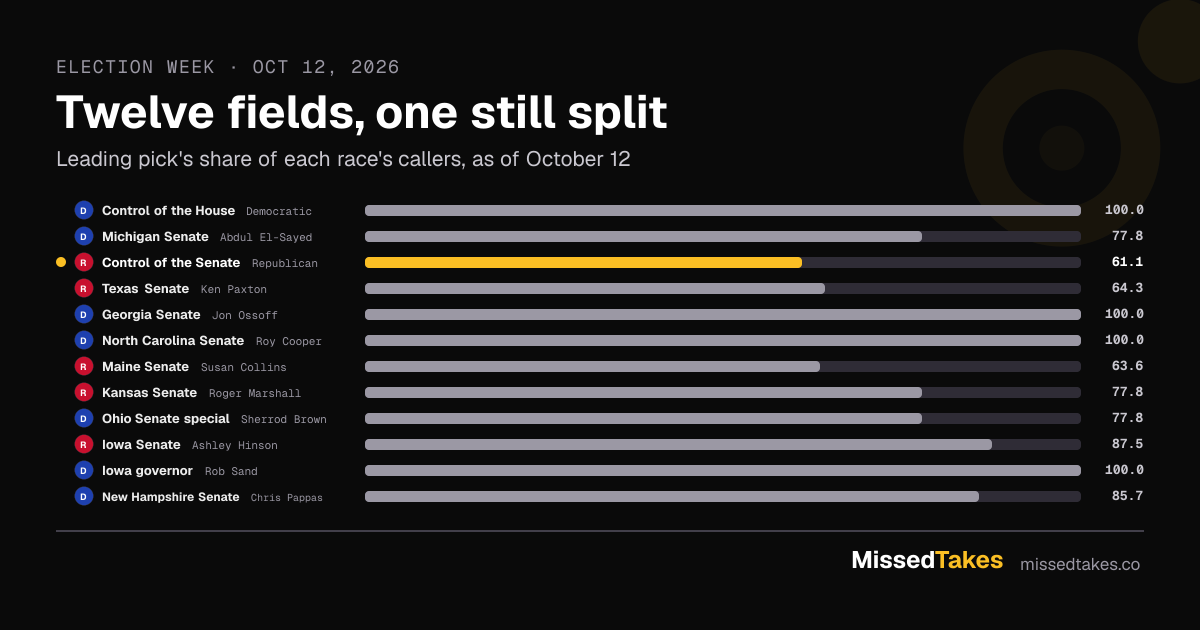
The biggest shift was in Michigan. Four weeks ago the Senate race there split 7 for Abdul El-Sayed and 4 for Mike Rogers among 11 callers. It's now 14 for El-Sayed against 4 for Rogers among 18, the field growing by seven callers and tilting further toward El-Sayed rather than settling. Maine moved almost as much in caller count, from 4 to 11, but the leading share actually shrank: Susan Collins held 3 of 4 callers a month ago and now holds 7 of 11, as new entrants split more evenly than the early movers did. Kansas and the Ohio special both roughly doubled their caller counts (4 to 9 in each case) without much change in the lead.
Forecasters against talkers
The House and Georgia and North Carolina Senate races show no daylight between the two groups, everyone, forecaster or talker, picked the same side. Control of the Senate is where they actually disagree: our two forecasters split one apiece between Republican and Democratic, while the 16 talkers go 10 for Republican and 6 for Democratic. Iowa's Senate race shows the same pattern in miniature. The two forecasters there split evenly between Ashley Hinson and Josh Turek, while all six talkers who've called it picked Hinson.
The market and the polls
Maine is the week's clearest disagreement between the people calling the race and the money and the polling behind it. Pundits favor Collins 7 to 4, but Polymarket has Troy Jackson at 59 cents to Collins's 42, and VoteHub's average (7 polls through October 5) has Jackson ahead by 2.1 points. Texas runs the same way: Ken Paxton leads the calls 9 to 5, while the market prices James Talarico at 63 cents and VoteHub's four polls have him up 2.1. Iowa's Senate race is closer to agreement, the market gives Hinson 59 cents to 43, in line with the near-unanimous talker lead, even though VoteHub's three polls put the race within half a point.
Changed minds of the week
Buck Sexton moved on Michigan between September 17, when he said "I think the GOP wins in Texas and Michigan. It will be super close in Michigan," and October 6, when he switched: "I think we lose in Michigan. ... I just think that Michigan race is going to be very tough for us." Chuck Todd moved on the Texas governor's race over a similar window, from a September 30 hedge on Greg Abbott ("he's still the favorite to win, but he might lose") to an October 5 call for Gina Hinojosa: "I do think [Abbott] loses. It's schools is why he loses." Ryan Girdusky's shift on Alaska was narrower, from a generic Republican call on September 28 to naming Dan S. Sullivan specifically on September 30, still the same side of the race, just a sharper version of it.
Standing alone
Five calls this week stood against the rest of their field. David Nir, one of the cycle's 11 forecasters, is the only caller on Josh Turek in Iowa, against seven who picked Hinson. Nir carries a 96.3% accuracy figure on 26 graded calls from last cycle, among the strongest records we track, though his MissedTakes Score of -0.5 shows that even that accuracy came out a touch below what a simple baseline forecast would have scored, a sign his calls tend to land on races that were not especially close to begin with. Buck Sexton is alone on John E. Sununu in New Hampshire against six, and Girdusky is alone on Sullivan in Alaska against six, both pundits carrying modest graded records (59.9% and 63.6% accuracy on 25 and 16 calls). Chuck Todd stands alone on Hinojosa in Texas against three other callers, with no graded record from last cycle to measure him against. Ari Weitzman is alone on Dan Osborn in Nebraska against three, on a record thin enough, six graded calls, to make the 20% accuracy figure attached to it more a note than a verdict.
On the record
Every call above is still unresolved, and will stay that way until votes are counted. For the full list of races and the pundits calling them, see our US Elections hub and the election leaderboard.