Pundits Add Seven Callers to the House Race, and Still Nobody Picks Republicans | MissedTakes Election Week
Drafted by a language model from MissedTakes' graded data, then reviewed and approved by Ben Garves before publishing. How our posts are made
How many calls landed this week?
Pundits logged 68 calls between October 12 and October 19, bringing the cycle total to 487 from 84 pundits, 11 of them forecasters rather than talkers. Most of the week's volume was ordinary race-winner picks (48 of the 68), with 14 more calls on control of Congress and 5 on seat counts. Only one margin call and no new national House popular-vote calls came in over the week.
Where does the field stand, race by race?
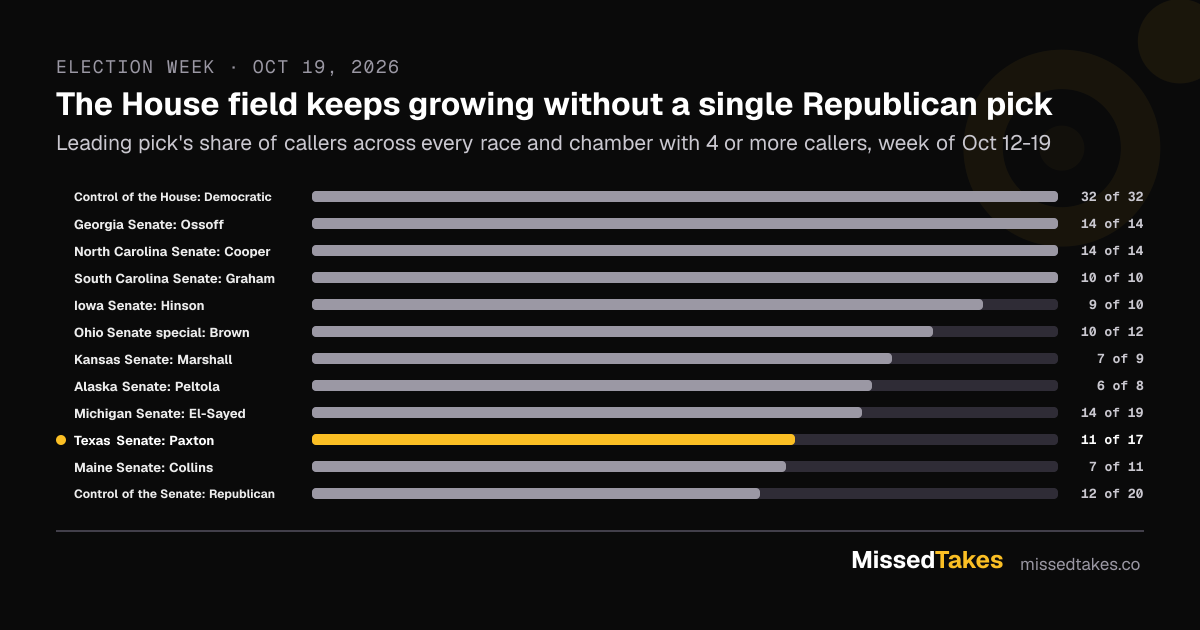
Twelve races and chambers now carry four or more callers, and the biggest mover by raw count is control of the House: 32 callers have now made a call, up from 25 four weeks ago, and every single one of them still says Democratic. That is a wider field than any other subject tracks, and it hasn't produced one dissenting pick.
Control of the Senate is the field's one real divide: 12 of 20 callers say Republican, 8 say Democratic, almost unchanged from four weeks ago when it was 12 of 19. Georgia, North Carolina and South Carolina are unanimous at the top (Jon Ossoff, Roy Cooper and Darline Graham each hold every caller in their race), while Michigan, Texas, Ohio's special election, Maine, Iowa, Kansas and Alaska all carry a real minority pick.
| Race or chamber | Leading pick | Callers now | Callers 4 weeks ago |
|---|---|---|---|
| Control of the House | Democratic | 32 of 32 | 25 of 25 |
| Control of the Senate | Republican | 12 of 20 | 12 of 19 |
| Michigan Senate | Abdul El-Sayed | 14 of 19 | 14 of 18 |
| Texas Senate | Ken Paxton | 11 of 17 | 9 of 14 |
| Georgia Senate | Jon Ossoff | 14 of 14 | 14 of 14 |
| North Carolina Senate | Roy Cooper | 14 of 14 | 12 of 12 |
| Ohio Senate special | Sherrod Brown | 10 of 12 | 7 of 9 |
| Maine Senate | Susan Collins | 7 of 11 | 7 of 11 |
| Iowa Senate | Ashley Hinson | 9 of 10 | 7 of 8 |
| South Carolina Senate | Darline Graham | 10 of 10 | 7 of 7 |
| Kansas Senate | Roger Marshall | 7 of 9 | 7 of 9 |
| Alaska Senate | Mary Peltola | 6 of 8 | 6 of 7 |
Where do forecasters and talkers split?
Texas is where the two groups disagree most. Both of the race's forecasters, including Geoffrey Skelley ("narrowly favored, 58%" on October 8), have called James Talarico; among the field's talkers, 11 of 15 say Ken Paxton, including Ben Shapiro and Erick-Woods Erickson. Chuck Todd is on the Talarico side too, calling it "still the most likely result" on October 6 and putting a 2-point margin on it the next day.
Iowa shows the split inside the forecaster ranks themselves: David Nir called Josh Turek on October 8, while Kyle Kondik has had Ashley Hinson ("Leans Republican") since September 16. Talkers are lopsided here, 8 of 8 for Hinson among the pundits we've tracked picking a side.
Michigan is the one race where forecasters and talkers broadly agree: both of the race's forecasters and 12 of its 17 talkers have Abdul El-Sayed.
How does the field compare with the market and the polls?
Texas is the clearest gap between pundits and the price. Polymarket has James Talarico at 63 cents to Ken Paxton's 38 as of October 19, and VoteHub's average (7 polls through October 14) has Talarico ahead by 1.6 points, yet the field of callers runs the other way, 11 of 17 for Paxton. Maine shows a similar split: the market prices Troy Jackson at 61 cents and the poll average has him up 2.6 points, but the field's talkers favor Susan Collins 7 of 10.
Iowa is closer to agreement. Polymarket has Hinson at 59 cents and VoteHub's average (5 polls through October 12) has Turek ahead by just 0.5 points, functionally a tie, while the field leans Hinson, 9 of 10. Michigan and the two unanimous Senate races (Georgia, North Carolina) show no tension at all: markets and polls there point the same way the field already does, by double digits in Georgia and North Carolina's cases.
Who changed their mind, and when?
Buck Sexton flipped Michigan. On September 17 he said "I think the GOP wins in Texas and Michigan. It will be super close in Michigan." By October 6 he'd reversed: "I think we lose in Michigan. ... I just think that Michigan race is going to be very tough for us." Sexton carries a 59.9% accuracy mark on 25 graded calls from last cycle, a small enough sample that the record is better read as a rough guide than a guarantee.
Chuck Todd flipped the Texas governor's race. On September 30 he hedged toward Greg Abbott: "My guess is they come up a little short with Abbott, but let's say Abbott loses. ... he's still the favorite to win, but he might lose." By October 5 he'd moved to Gina Hinojosa: "It's unbelievable what they've done. And I do think Babbitt loses. It's schools is why he loses."
Who's standing alone?
David Nir is the lone pundit on Josh Turek in Iowa, against 9 callers on Hinson. What makes the call worth a look is that it actually lines up with VoteHub's poll average, which has Turek narrowly ahead (by 0.5 points) even though Polymarket and the rest of the field favor Hinson. Nir carries a 96.3% accuracy mark across 26 graded calls last cycle, built almost entirely on race-winner picks, though the sample remains limited enough that one number shouldn't be read as a guarantee for this one.
Alaska has two lone calls pointed at the same idea from different angles: Ryan Girdusky named Dan S. Sullivan directly, while Ben Shapiro simply called the seat Republican, both against the 6 of 8 callers on Mary Peltola. Buck Sexton is alone on John E. Sununu in New Hampshire (against 6), and Ari Weitzman is alone on Dan Osborn in Nebraska (against 4), a pick that sits oddly next to Weitzman's 20% accuracy on a six-call sample from last cycle: small samples can flatter a pundit just as easily as they can punish one.
For the full field of calls on every race, see the US Elections hub; for how every pundit has graded out historically, see the election leaderboard.